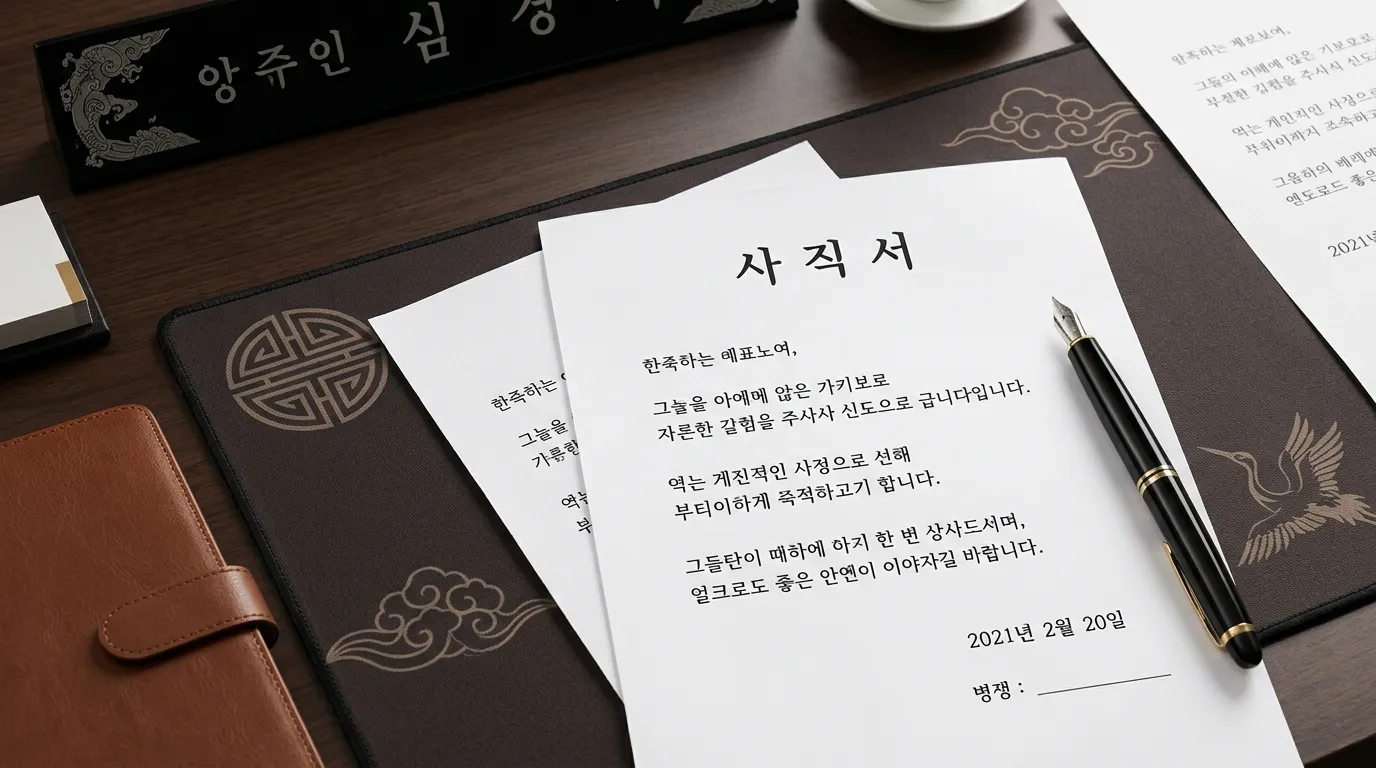
A Korean letter of resignation is called a 사직서 (sajikseo). It is a short, formal, one-page document that states your name, position, last working day and a polite reason for leaving, usually “personal reasons” (일신상의 사유). Most Korean employers expect it in writing, signed and handed over after you have spoken with your manager.
If you work in Korea, or at a Korean company abroad, this guide gives you a ready-to-use template in Korean and English, plus the notice rules and etiquette that trip up many foreign employees.
What Is a Korean Letter of Resignation (사직서)?
A 사직서 is the written notice that you are ending your employment. You may also see 사직원, which is a “request” to resign, and 퇴직서 or 퇴사 신청서, which are used at some companies.
The difference matters a little. A 사직원 asks for approval, while a 사직서 simply informs. In practice, HR departments treat them the same, and many companies have their own form. Ask HR before you write one from scratch.
Quick Answer: What Goes in a Korean Resignation Letter?
A standard 사직서 contains these parts:
- Title: 사 직 서 (written with spaces between the characters, centered)
- Your details: department (소속), job title (직위), name (성명)
- Hire date: 입사일
- Intended last day: 퇴사 예정일
- Reason: usually 일신상의 사유 (personal reasons)
- Closing statement: “I submit my resignation as above.”
- Date and signature or seal
- Addressee: the company name and CEO, followed by 귀하
Keep it to one page. Korean business culture values short, respectful and non-confrontational wording.
Korean Resignation Letter Template (Korean + English)
Korean version
사 직 서
소속: 마케팅팀
직위: 대리
성명: 홍길동
입사일: 2022년 3월 1일
퇴사 예정일: 2026년 12월 31일
위 본인은 일신상의 사유로 인하여 상기와 같이 사직하고자 하오니 허락하여 주시기 바랍니다.
2026년 11월 30일
성명: 홍길동 (서명 또는 인)
○○주식회사 대표이사 귀하
English translation
Letter of Resignation
Department: Marketing Team
Position: Assistant Manager
Name: Gildong Hong
Date of Hire: March 1, 2022
Intended Last Day: December 31, 2026
For personal reasons, I hereby wish to resign from my position as stated above. I kindly ask for your approval.
November 30, 2026
Name: Gildong Hong (signature or seal)
To the CEO of ○○ Co., Ltd.
Swap in your own details. The phrase “허락하여 주시기 바랍니다” is the traditional polite ending. A more modern version is “수리하여 주시기 바랍니다” (please accept).
Do You Have to Give a Reason?
No. Almost every Korean resignation letter says 일신상의 사유 (personal reasons), and that is considered correct and polite. Don’t use the letter to criticize the company, your manager or your colleagues. If you have real complaints, raise them in an exit interview, not in writing.
One exception: if you resign for reasons that could affect unemployment benefits, such as unpaid wages or a serious change in working conditions, talk to the Ministry of Employment and Labor or a labor attorney before you submit anything. The reason you write can matter later.
How Much Notice Should You Give in Korea?
This is the question foreign employees ask most.
- Under Korean civil law (Civil Act, Article 660), an employee on an indefinite-term contract can resign at any time. The resignation generally takes effect one month after notice is given.
- Many companies write their own notice period into the employment contract or work rules, commonly 30 days, sometimes longer for senior roles.
- Fixed-term contracts follow different rules. Leaving early may have consequences, so read your contract carefully.
Check your contract first. If the company’s rule is stricter than what feels reasonable, that is a conversation to have with HR, not a reason to simply stop showing up.
Laws and enforcement details change, so confirm current rules with the Ministry of Employment and Labor (고용노동부) or a certified labor attorney (공인노무사).
Step-by-Step: How to Resign in Korea Politely
- Read your contract and work rules (취업규칙) for the notice period.
- Tell your direct manager first, in person or by a private call. Never let your manager hear it from HR or a coworker.
- Submit the 사직서 after that conversation, on your company’s form if it has one.
- Agree on a last day and a handover plan.
- Hand over your work with clear documents and notes.
- Return company property: laptop, ID card, access cards, documents.
- Say thank you to your team. In Korea, leaving on good terms matters because industries are small and references travel fast.
Korean Resignation Etiquette Tips
- Speak before you submit. A letter handed over by surprise can feel rude.
- Be humble. Even if you are leaving for a better offer, avoid bragging.
- Use formal language. Choose 합니다체 (formal polite style), not casual speech.
- Don’t resign during a crunch if you can avoid it. Timing is noticed.
- Keep a copy. Take a photo or ask HR to confirm receipt in writing.
- Expect counter-offers or pressure to stay. Decide your answer beforehand.
What Happens After You Submit Your 사직서?
Severance pay (퇴직금): Employees who have worked at least one year, and at least 15 hours a week on average, are generally entitled to severance of about 30 days of average wages for each year of service. Employers are normally required to pay within 14 days of your last day.
Unused annual leave: Unused leave may be paid out depending on your situation and company rules.
Unemployment benefits (실업급여): Voluntary resignation usually does not qualify, though there are exceptions for specific justified reasons. Check before you submit.
Documents you may need: a certificate of employment (경력증명서), a withholding tax receipt (원천징수영수증) and a resignation confirmation if you are applying for benefits or a new job.
Visa holders (E-2, E-7 and similar): Changing or ending a job can affect your visa status, and there are reporting deadlines. Contact Immigration or HiKorea promptly, since this is time-sensitive.
Common Mistakes to Avoid
- Writing a long emotional explanation
- Submitting the letter without telling your manager first
- Setting a last day that ignores your contract’s notice period
- Forgetting to ask for a copy or confirmation
- Leaving before severance and tax documents are sorted
- Assuming your home country’s resignation rules apply
Frequently Asked Questions
What is “Korean letter of resignation” in Korean?
It is 사직서 (sajikseo). Some companies also use 사직원 or 퇴직서.
Can I write a Korean letter of resignation in English?
Yes, if your company works in English or you are at a foreign-owned firm. Many Korean companies still prefer a Korean-language form, so ask HR. You can attach an English copy for your own records.
Should I handwrite or type my 사직서?
Both are accepted, depending on the company. Some older firms still prefer a handwritten letter with a signature or seal (도장). Typed versions are common at modern companies, and many HR systems accept an electronic form.
Is two weeks’ notice enough in Korea?
Often not. The Civil Act’s default is one month for indefinite-term contracts, and many contracts say 30 days. Check yours.
Can my employer refuse my resignation?
For indefinite-term employees, resignation under the Civil Act generally takes effect after the notice period, whether or not the employer “accepts” it. If your employer refuses to process it or threatens you, speak to a labor attorney or the labor office.
What reason should I write?
“일신상의 사유” (personal reasons) is the standard and safe choice.
Do I still get severance if I resign voluntarily?
Yes, if you meet the eligibility conditions (usually one year of service and a minimum weekly working time). Resigning does not by itself cancel severance.
Final Thoughts
A good Korean letter of resignation is short, polite and clear. Talk to your manager first, follow your contract’s notice period, use the standard 사직서 wording, and keep the tone respectful. That keeps your professional reputation intact, which counts for a lot in Korea’s tight-knit industries.
Use the template above, adjust the dates and details, and ask HR whether they require a company-specific form.
You can visit all News